

Infinity beyond mathematics and ... in mathematics
INFINITY BEYOND MATHEMATICS AND… IN MATHEMATICS
research st. Eng. Ch. Lucretia Euenia BREZEANU
The word "infinite" is an adjective used to describe something that has no limit in number or size. It comes from the Latin infīnītus, derived from fīnītus "limited", "to delimit", but also: "to specify", "to determine" and "to finish"; therefore literally means "which is without limits", but also "indeterminate" and "undefined". When it is a noun, infinity fundamentally denotes a mathematical notion, as well as a philosophical, metaphysical or theological concept, whose paradoxes have long nourished and have nourished the history of thought throughout the world.
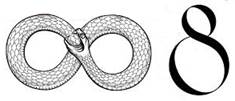
Symbols of infinity
The symbol for infinity, in mathematics and beyond mathematics, is "∞", invented by the mathematician John Wallis in the 17th century, a sign whose origin is controversial and whose shape may evoke a horizontal "8" (but not in relation to the number 8 this sign was chosen); This shape has been compared to those of the Bernoulli lemniscate or the Möbius strip. These are also possible representations of the infinite or the inaccessible perpetual motion, but representations "at the limit" precisely, for a concept that is by definition or by nature impossible to represent.
The notion of infinity has strongly marked the history of Western philosophy at least since Greek antiquity in the attempt to reconcile Christian theology in its reflections on the character of the divine nature as real or "actual" infinity, with Neoplatonic thought and Aristotelianism, especially with Aristotle's conceptual distinction between "the actually, actual, and concrete infinite, which cannot be imagined in nature, the infinite, actual, and concrete to exist", but only as an abstract concept and potentiality.
The major stages of this reflection were probably, since the mysterious Book of Philosophers XXIV, from the 4th century to the 15th century, some works by some such as: Marius Victorinus, Boethius, John Damascene, Thomas Aquinas, Raymond Lull, John Duns Scotus, Nicole Oresme and especially Nicholas of Cusa with his vision of an infinite universe made up of an infinity of finite worlds all singing the glory of God present everywhere (with the risk, for the Inquisition, of confusing the Creator with his creation) that brought punishment to Giordano Bruno, at the dawn of the 17th century.
The notion of infinity has seen a spectacular comeback in Western thought, as well as in the history of mathematics and science, since the 17th century, notably through the development of infinitesimal calculus by Fermat, Leibniz, and Newton, and in the works of Descartes, Pascal, and Spinoza. These innovations in mathematics but also in physics led to a radical change of perspective. Thus, Alexandre Koyré states that "the substitution of an infinite and homogeneous universe for the finite and hierarchically ordered cosmos of ancient and medieval thought implies and requires the reformation of the first principles of philosophical and scientific reason".
In the ancient Egyptian religion, Nun was the name of the god of an infinite ocean existing before the creation of the world!
China had a theory of infinity developed by Mozi, one of the "hundred schools" of philosophy that emerged in China during the Warring States period, which challenged Confucian and Taoist teachings around -300. This theory was published in the founding text of this school, a collection of the words and thoughts of its master: Mozi.
India in the Yajur-Veda (Indian mathematics of the Vedic period: -1500 to -4000), documents the earliest known use of numbers up to one hundred thousand trillion (parārdha in Sanskrit). The concept of numerical infinity, pūrṇa, is also used, establishing that if one subtracts pūrṇa from pūrṇa, pūrṇa remains!
In the 2nd century, the scholar Pingala described in his work "Chhandahshastra" a system of binary notation, used for classifying syllables in music. His system used the terms "laghu" and "guru" to represent what we know today as "0" and "1". This description predates the binary system developed by the German mathematician Gottfried Leibniz in 1703 by about 1,500 years, a system that later became fundamental to the development of modern computers.
The pre-Socratic philosophers were actually the first physicists (phusikoi). Indeed, being the first to dare to study nature for itself, they came to establish a method of analysis, research and reflection that would later become that of scientists and philosophers. To this end, much of the scientific language still used today was introduced by these thinkers and originally had the function of expressing concepts essential to the development of the study of nature.
The universe, kosmos, principle (archè), reason (logos), nature (phusis) are terms for getting to the core of things to discover their mechanism. Thus, the traditional functions of the divinities, until then conceived as external interventions, are "naturalized", the Presocratics will directly or indirectly use the concept of infinity / apeiron.
The Pre-Socratics do not believe that the infinite exists in vain, nor that it has any other value than that of a principle everything is a principle or comes from a principle, but the infinite does not come from a principle by the very fact that it is one.
The Infinite is ungenerated and incorruptible: Being ungenerated, the infinite receives no end and is therefore incorruptible. Aristotle was the first to list the theses of the pre-Socratic philosophies. On the infinite, in Book III of his Physics he enumerates the common points between the thoughts of his predecessors and the reasons that led them to believe in the existence of the infinite. Immortal and imperishable, the infinite appears to be divinity. Five reasons that led to belief in infinity. First, infinity is in the division of magnitudes.
Mathematicians use the infinity revealed by division. For example, the formula for the area of a circle π∙r2 is corroborated by dividing the circle into an infinite number of triangles.
There are an infinity of sources. Indeed, destruction and generation are not exhausted, it can only be because of the infinity of the source from which everything is generated.
Time is infinite! Every generation has an end, but the source has no principle to generate it and therefore has no end. Thus, the movement of generation and corruption is inscribed in time and is due to an ungenerated and incorruptible source, meaning that time itself is infinite.
There is no limit in itself. What is limited is only limited by something else, so nothing will be a limit, because limitation is always between two terms.
The infinite through some pre-Socratic theories
Apeiron: the concept of infinity was introduced for the first time in the thinking of the philosopher Anaximander (- 610 Miletus, – 546), student of Thales, who wanted to investigate the foundation of the universe and thus ended up postulating infinity as the principle and substratum of the things that exist: water for Thales, air for Anaximenes, fire for Heraclitus), because they are changeable, depend on each other and none can be privileged. Therefore, beyond the elements, another nature is needed to act as a substratum from which all worlds are generated. This substratum is the infinite, the principle that generates the universe under the influence of an eternal movement. Perpetual motion is in constant production in this sense, it is a "generic return".
Pythagorean School: Among its doctrines, the school proposes that of eternal return: things will be the same again. If for other philosophers, such as Anaximander or Heraclitus, a generic return can be observed, among certain Pythagoreans there is an individual return that can be reproduced ad infinitum.
Indeed, if there are 1) a finite number of possible events, 2) if each event has a cause, and 3) the same cause must always produce a similar effect, it follows that in infinite time events necessarily recur.
In the Nicomachean Ethics, Aristotle says that for the Pythagoreans evil is infinite. Heraclitus (second half of the 6th century around -544 Ephesus), fire is the principle of the universe: everything is convertible into fire and fire into everything. On the one hand, the infinite is found there by generation, because for him everything is realized by conflict and necessity, everything is directed towards its opposite. Infinity characterizes time because for Heraclitus, the universe has neither beginning nor end.
The cosmos was, is and always will be like "eternal fire". Parmenides (the end of the 6th century, Elea, the middle of the 5th century), the concept of infinity inherent in his thought is found in the explanation of the immobility and eternity of the being that must be eternal, that is, it is ungenerated and imperishable. Infinity is therefore necessary for the existence of an eternally identical being. Melissus, a student of Parmenides, believed that what exists, or rather what is, must be unique: there is only one thing. Based on his master's words, he states that a thing that exists always exists, but adds that it must always be infinite in size. The argument takes as its starting point the impossibility of a vacuum.
Democritus: (-460 Abdera, -370), nature consists of small substances, unlimited in number, which are found in a place he calls infinity. This infinity of small substances swimming in an infinite and eternal void sometimes agglomerate and form visible bodies by their motion. The infinite is thus found in a division of bodies into an infinity of substances, which constitutes the first atomic theory.
Other pre-Socratic thinkers also used the concept of infinity in their research, The dichotomy if there is motion, a moving body must move a certain distance in a finite time; but before the whole distance has been traversed, the body must first have traversed half of it; and before you have traveled half of it, you must have traveled half of that half. Since every distance is infinitely divisible into halves, and since it is impossible to traverse an infinite number of positions in a finite time, motion does not exist.
The Neoplatonists Plotinus, (-205-270), states: "One need not fear the limitlessness of the intelligible" (Eneade, V.7.1). Plotinus asserts the infinity of the One. While before infinity, apeiron, represented the lowest degree of existence, or even pure non-being, for Plotinus the essence of matter remains infinite in this negative sense, it becomes a positive attribute of the three hypostases: One, Intelligence, Universal Soul.
Avicenna (b. 980 Afshena, Bukhara, 1037), will include Aristotelian notions, but in a theological context. Thus, he takes up the idea of the eternal world, but in a creationist metaphysics. In the context of infinity, it is obvious that the existence of a God will give new meaning to Aristotle's metaphysics, which accepts infinity in potential (in the form of infinity by division and by addition) but rejects infinity in actual act.
The Infinite in the Superlunar World: We note first that God is by definition infinite and is the first principle from which everything emanates, but God is not the only infinite being; there is an ontological dependence of the heavenly intelligences (which number the gods) towards the first principle, a dependence expressed by the desire to approach God's perfection. Desire as the principle of movement is the fact of wanting to reach God, to resemble him.
If Avicenna speaks of the infinite in the sublunary world: the infinite in action is brought about by theology; the souls (of men) being immortal, there is therefore an infinity of them in an eternal world. This is what characterizes infinity in powerful action in Avicenism. There is an infinite succession of preparatory causes. This is where the distinction between essential causes and ancillary causes comes into play. Essential (or true) causes being related to motion, to continuity, because they remain with the effect. True causes "prevent the nonexistence of the thing." Auxiliary causes are secondary because they precede the work. We can think of the father/son relationship that is from generation to generation to explain this fact.
As for the strong potential infinity, it is always the same as Aristotle's potential infinity, namely infinity by division and by addition; infinity in weak power, is found in motion. This movement does not correspond to that of the celestial spheres and this is not really continuous and can be viewed in different ways. We can already see it as the general movement of a body. However, this definition of motion will not be the important one in the case of infinity.
In Aristotle, in Book VI of Physics, it is clear that "it is impossible for a continuum to be made up of indivisibles, for example for a line to be made up of points, if it is true that the line is a continuum and the point an indivisible one".
From mathematical infinity to theological infinity: According to Aristotle's definition in Book III of the Physics, "infinity is that which is such that when one takes a quantity from it, that is, no matter how great the quantity one takes, there is always something left to take."
Absolute Infinity: A Theological Foundation! addressed in the Mitteilungen, even if it relates more directly to speculative theology, still serves as a foundation for the theory of the transfinite.
The //transfinite// numbers are accessible to man, but their set, that is, the system of all "Ω" numbers, is incomprehensible.
Russell Bertrand (1916) for whom infinity became a problem
Russell's definition of number works with the definition of number advanced in Fundamentals of Arithmetic: "the class of all classes similar to the given class". This definition of number allows Russell to provide the logical proof of four of the five axioms of Peano arithmetic.
In mathematical logic, an arithmetic set is a set of natural numbers that can be defined by a formula composed of the first ordinal (Peano arithmetic). Arithmetic sets are classified by the arithmetic hierarchy.
As Leibniz suggests, an infinitesimal would be an amount of space or time so small that there would be no smaller one, so that it would be impossible to divide it into two finite amounts. Russell rejects the possibility in mathematics to manipulate infinitesimal quantities, namely quantities such that "any finite distance is greater than this".
Infinity in the 21st century, in mathematics: For the vast majority of 21st century mathematicians, infinity in each of its meanings is a mathematical notion like any other, which possesses an explicit definition and which, in principle, could be reduced to the primitive objects of the language used (most often that of Zermelo-Fraenkel set theory). Thus, for example, a set is infinite (in Richard Dedekind's sense) if it can be bijected with one of its strict subsets; the point at infinity of a space is a formal object added to this space by following precise rules, etc.
Attempts to render the meaning of infinitesimals and various "orders of infinity" (to be able, for example, to express that the square of infinity is much greater than infinity) were made by du Bois-Reymond, Hardy and Landau; they consist in introducing reference functions (scales of comparison) and saying, for example, that a quantity varies under certain conditions as an infinitesimal of some order or other if it is equivalent to one of the functions of the scale, itself very small under the same conditions. But these definitions, although useful in practice, suffer from a certain arbitrariness and are also necessarily incomplete (there are always functions lying outside a given scale).
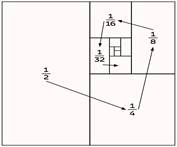
The geometric series 12n fills a square with side and area equal to 1, to the initesimal
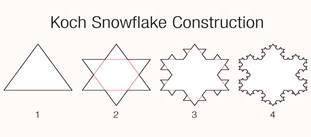
The Von Koch snowflake is constructed by adding a triangle to each edge of the previous figure… ad infinitum; to the infinitesimal
Non-standard analysis and surreal numbers Advances in mathematical logic in the first half of the 20th century led various theorists (Hewitt, Robinson and Nelson in particular) to consider reconstructing a rigorous theory of infinitesimals based on model theory. In this approach, we build, for example, a model of "non-standard" real numbers, which contains all the usual real numbers but also new numbers, not necessarily "infinitely large" or "infinitely close" to the old ones; the results of the theory guarantee that these new real numbers have all the properties of the old ones (the apparent paradoxes, such as that of the smallest non-standard integer, which had led to the abandonment of these conceptions in the 19th century, being solved by the impossibility of expressing certain properties in the precise language used).
Geometry and topology: The notion of a point at infinity, which arose with the development of projective geometry (itself developed in relation to the invention of geometric perspective) was intended to model the well-known phrase that "parallels intersect at infinity" is now formalized by the construction of projective geometry.
In physics: At the beginning of the 20th century, physics found itself unable to explain various phenomena including the fact that a black body in thermodynamic equilibrium should radiate an infinite flux, see ultraviolet catastrophe. This problem was solved by Planck's introduction of quanta, which form the basis of quantum physics. In several branches of physics, such as quantum field theory or statistical physics, researchers have been able to remove unwanted divergences from the theory using mathematical renormalization techniques. These techniques have not yet been applied to the theory of gravity!
The number of this volume is 38! In metapsychic sciences
38 often represents the trinity in religions and is associated with creation, procreation, trust, creativity, self-expression, optimism, joy, courage, material abundance and reality; that's good news!
38 is the sum of the squares of the first three prime numbers ( 2, 3, 5 and 4+9+25 = 38)
37 and 38 are the first pair of consecutive positive integers that are not divisible by any of their digits, by 3, 7, 8.
The meaning of the number 38 in numerology: it symbolizes confidence, creativity, self-expression, optimism, joy, courage, material abundance and reality. Number 38 signifies progress – in terms of wealth, career, spirituality and life.
Spiritually, the number 38 is a sign that it is your connection to the divine realm that allows many financial rewards and abundance to flow in TIME! Positive actions, prayers, and affirmations will help maintain this connection.
This number warns of a big step into your supernatural work and professional life or a breakthrough in your spiritual side.
The number 38 as a twin flame number tells you to stay on your chosen path and soon you will meet your twin flame!
If you have not yet made this connection, it is a sign that you will soon unlock a spiritual breakthrough in the days ahead. A twin flame can be a family member, friend or mentor. Stay focused on your mission.
Spiritual Meaning: To understand the number 38, we must break it down into the numbers from which it receives its vibrational essence: 3, 8 and 11. The number 3 is associated with confidence, autonomy and optimism, a symbol of immense wealth.
The number 3 resonates with the materialization of ambitions; it is also associated with naturalness, growth and development, clarity and eloquence.
The number 8 is a symbol of infinity, endless cycles and abundance! it can symbolize authority, self-confidence, strength and inner wisdom, social status, ego and the desire for peace. // 8 // symbolizes material wealth, prosperity, success, independence, insight, honesty, precision, balance and loyalty. This number is often associated with financial blessings and success.
When the numbers are added together, they equal the master number 11 high frequency number that contains energies of creativity, inspiration and spirituality. This main issue emphasizes understanding the mystical and the metapsychic.
Number 38 is a mixture of the attributes of these two numbers, 3 and 8. According to numerology, number 38 symbolizes a message to encourage you, showing that "some kind" of wealth will materialize as goals are to be met in times to come!
38 symbolizes staying on track, taking positive action, achieving material abundance, and listening to your inner wisdom.
This number is reminiscent of karmic law – the law of giving and receiving, meaning that if you have a lot, you can share a lot, it is a sign that it is the connection with the divine realm that allows many financial rewards and abundance to flow into the entity's TIME.
38 Atomic number of Strontium, a very reactive element of soft metallic, silver-white and yellow color when it comes into contact with air much more reactive with water, with which it reacts to form Strontium hydroxide and Hydrogen gas! Strontium occurs in nature in celestine and strontianite. While natural strontium is stable, its synthetic isotope 90Sr is radioactive, found in radioactive waste, and has a half-life of 29 years. Strontium is stored under a liquid hydrocarbon such as kerosene or mineral oil to prevent oxidation. Fine metallic strontium in powder form is very piroforic, spontaneously igniting in air at room temperature. Strontium salts impart a bright red color to flames, which is why they are used in pyrotechnics and in the production of flares.
Astronomy: Messier object M38, an open cluster of magnitude 7 in the constellation Auriga; the subject of the new general catalog NGC 38, a spiral galaxy in the constellation Pisces
The Ishihara test is a color vision test consisting of 38 pseudoisochromatic plates. Most people will see the number 38, but people with red-green color blindness might see 88 instead.
The 38th parallel north is the border between North and South Korea at the Korean War; The Class 38 is the most famous class of steam locomotive used in New South Wales; 38 slots are on an American roulette wheel!
A "38" is often the name of a .38 caliber snub barrel revolver.
Cats have a total of 38 chromosomes in their genome.
BIBLIOGRAPHY
1. The mathematical infinity between mystery and reason, intuitions, paradoxes, rigor, by Thérèse Gilbert, Nicolas Rouche, ELLIPSES, 15.07. 2001
2. A (very!) short history of infinity 23.02. 2022 Pierre Henriquet (PhD in nuclear physics and columnist at Polytechnique Insights)
3. "The latest news about INFINIT, magazine //For science//, special number no. 125, November-December 2024
4. "Giordano Bruno, prophet of the infinite, burned alive by the Catholic Church, Delbecq 2020
5. Gaffiot dictionary, "infīnītus", "fīnĭo, fīnis", chapter author, Félix Gaffiot, 1934
(accessed 4 February 2022),
6. Maria Reményi, "History of infinity", magazine //For science//, no. 278, 2000,
7. Metaphysical meditation, Emmanuel Levinas, Encyclopædia Universalis on: "INFINITY, philosophy", Introduction (accessed February 2022)
RECOMANDARE: The Art of the infinite: Our Lost Language of Numbers, ROBERT KAPLAN, ELLEN KAPLAN, 2003, PENGUIN BOOKS
